
Hey, I’m Isaac 👋 I founded Pistachio, where we’ve worked with brands like BuzzFeed and Clay to understand their audience, build trust and deliver measurable outcomes through content-led growth.
If you want to chat about your own strategy, book a free call here.
Want to get your brand in front of 60k+ marketers?
See our partnership options here
Nike’s Collaboration Playbook
In 2024, one of the biggest brands in the world was facing an existential crisis.
96% of US sneaker consumers were aware of Nike (and frankly, what were the other 4% doing?). But, awareness wasn't growing the business anymore. Revenue was plummeting. Stock prices were tanking. They’d spent years optimising for digital efficiency and performance marketing. Somewhere in all that optimisation, they'd stopped mattering.
Everyone knew Nike. Few cared.
When Elliott Hill took over as CEO in October 2024, he had a mission to make Nike feel dangerous again. Not through better ads or bigger media buys, but largely through collaborations that reminded people why this brand existed in the first place.
Creating a collab that's for everyone means you lose resonance. In 2025, Nike proved that specificity beats scale, dominating six of the year's top ten sneaker collaborations. Not through reach, through relevance.
Nike leads the sneaker category on the metrics that actually drive conversion. 38% of consumers aware of the brand say it's "for people like me", compared to a category average of 25%. They're seen as the most innovative (40% vs 24% average), and the most worth paying more for (32%).
This is not luck. It’s systematic application of an important cultural principle most brands completely ignore.

The Collaboration Trap
Brand collaborations are everywhere now, but the hit rate is brutal. That comes down to choosing the right partner.
Most brands pick collaborators on vibes. "They feel like a good fit." "The audience seems right." "It could be exciting." When you dig into why they chose that specific partner, the answers get vague fast.
Tracksuit partnered with collaboration strategist Bimma Williams to solve this problem. They built the COLLAB Index, a scoring system that measures what actually makes collaborations work. It tests six dimensions that separate cultural impact from expensive mistakes:
Chemistry: Do the collaborators share real values and intent?
Originality: Did the idea bring something genuinely new?
Legacy: Does it meaningfully connect to brand or cultural roots?
Leadership: Did it move the category forward?
Audience Engagement: Did it invite people in and create participation?
Brand Energy: Did it generate momentum that translated into cultural heat?

They tested sneaker collaborations on their consumer reality (though Tracksuit data from over 2,000 qualified participants) and their cultural reality (through Bimma’s network of creators, journalists and strategists).
Nike scored highly across these dimensions by systematically choosing collaborators who could deliver on multiple fronts. Six of their collaborations made the top ten.
The best collaborations were both true and surprising. Truth without surprise is boring, everyone already knows that about you. Surprise without truth is gimmicky, it gets attention but lacks meaning. Both together creates cultural energy and commercial lift.

Sneaker culture itself is already rich with niche community nuances and associations. But it’s also are where brand collaboration culture was born, and arguably where it’s most pressure-tested.
Here's how Nike regularly nail both the “true” and “surprising” elements in their sneaker collabs.
A'ja Wilson: The Overlooked Audience Play
Let's start with the collaboration that shouldn't have taken this long.
A'ja Wilson is only the second Black woman in Nike's history to receive a signature shoe. The last was Sheryl Swoopes, 22 years ago. That gap is pretty telling about who the industry was building for.
But this was a relevance problem more than a reach problem. The audience had seen A'ja dominate. Finals MVP. Defensive Player of the Year. Scoring title. Regular-season MVP. Champion.
The only player in NBA or WNBA history to achieve all of that in one season.

Women weren't ignoring Nike. Nike wasn't looking at them.
Among sneaker consumers aware of both Nike and A'ja, only 14% knew about the collaboration overall. But the moment women actually saw the A'One, they became its biggest champions.
80% likeability among women, up from a 71% baseline. 82% among Millennials. 82% among Black and African American consumers. 89% said the partnership fit.
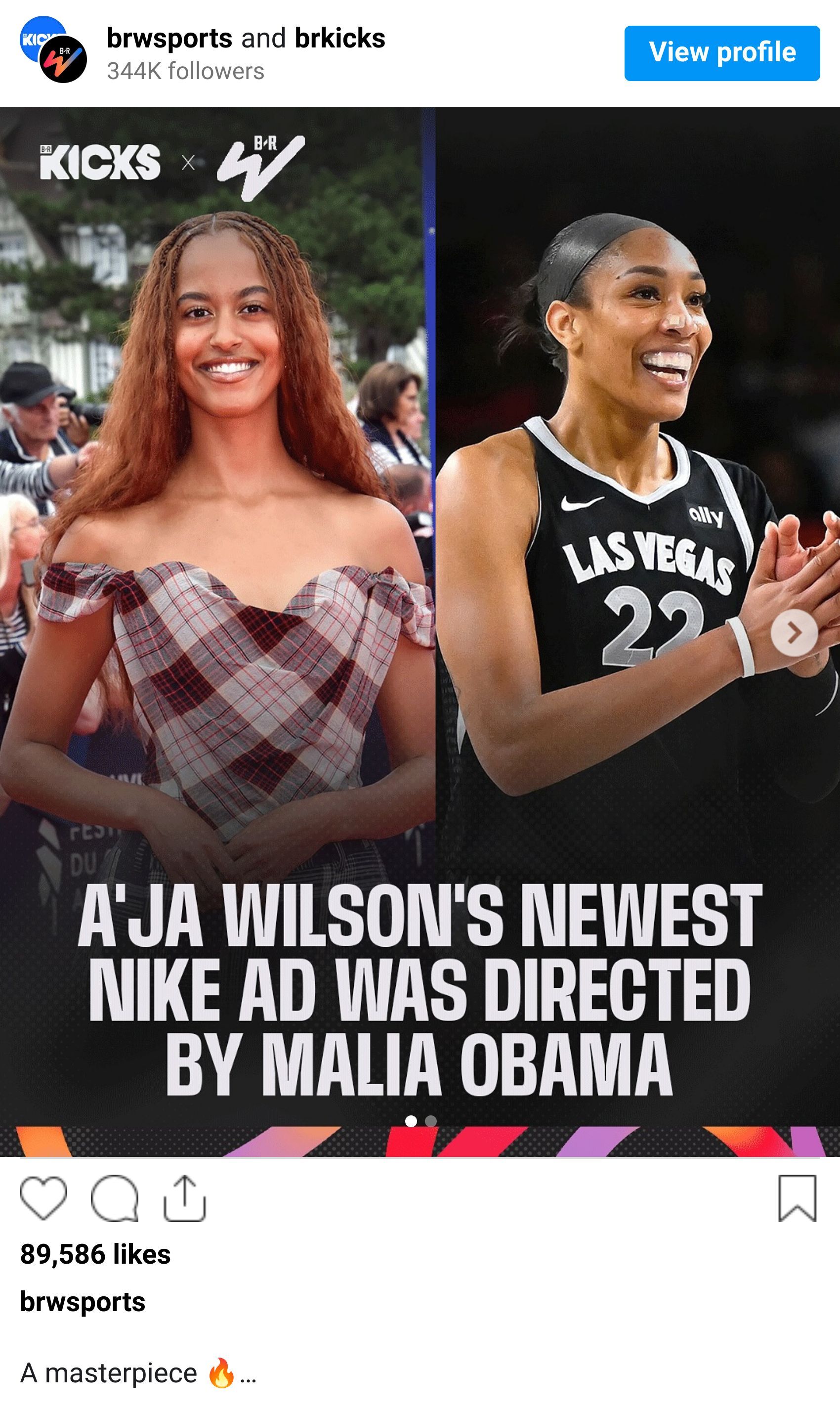
Nike paired the product with a campaign led by Malia Obama. Not a corporate campaign, but a fresh creative voice who could tell the story authentically.
On the COLLAB Index, the A'One scored high on Chemistry (89%) and delivered strong Audience Engagement. The collaboration was true, A'ja's values and Nike's stated commitment to women's sports aligned authentically, and it was also surprising, this was an overlooked audience.
The strategic insight here is actually pretty simple. Women of colour didn't suddenly gain buying power, Nike finally delivered a product worthy of it. This wasn't about winning new customers, it was about finally serving ones who were already there.
Nigel Sylvester: The Intensity Over Reach Playbook
Now let's talk about what happens when you completely abandon the reach playbook.
Nigel Sylvester is technically a BMX rider, but that's his side quest at this point. He's a designer, storyteller, community anchor, and the blueprint for what a modern Jordan collaborator looks like. Not a single-lane athlete. A creative athlete who brings an energy the Jordan Brand can't generate on its own.

The "Brick by Brick" Jordan 4 collaboration had 4% overall awareness. Four percent.
If you presented that number in a marketing deck, someone would ask why you're wasting budget on such limited reach. But here's what happens when you look at the right audience.
67% awareness among people who knew both Jordan Brand and Nigel Sylvester. That's the sharpest awareness lift in the entire research report.
Among that qualified audience, the numbers stay strong. 86% chemistry rating. 77% found it surprising. 76% said it increased their interest. 76% likeability.

The activation matched the strategy. Nigel drove a giant brick truck through Nolita and shut down the street. Not a polite brand moment. A statement.
The COLLAB Index reveals what made this work. High Chemistry (86%) proved the partnership felt authentic. Strong Originality (77%) showed it expanded what people thought Jordan could be. Plus exceptional Brand Energy transfer, Nigel brought momentum Jordan couldn't manufacture internally.
Forty years ago, Michael Jordan turned a banned sneaker into a movement. When Nigel blocked traffic with a brick truck, it landed like a modern echo of the same energy.
Low visibility. Outsized impact. Proof that when alignment is right, you don't need everyone to know about it. You need the right people to care about it.
Yu-Gi-Oh: When Fandom Becomes Strategy
The Air Muscle 95 collaboration with Yu-Gi-Oh is the most extreme version of Nike's specificity strategy.
Nike's dotSWOOSH division looks after their gaming and digital wearables. With this drop, they went all-in on trading card fandom. Two collector universes colliding.

The shoe itself is a deep cut from the anime. Joey Wheeler is a character from Yu-Gi-Oh, and Nike made his fictional sneakers a reality. They split the releases between the US and Japan and even included a playable card in the box.
This wasn't built for mass appeal. It was built for believers.

The collab sneaker (left) and Joey Wheeler’s character sneaker (right)
Among sneaker consumers aware of both Nike and Yu-Gi-Oh, 42% said the partnership fit. That's lower than the other collaborations, and that's exactly what you'd expect from a niche play. 63% found it fresh and surprising. 49% liked it.
Classic niche math. The people inside the circle loved it. The people outside didn’t really get it.
Fandom is the cleanest path to relevance in a world drowning in reach. Instead of spray and pray, Nike hit the exact pocket of people who deeply care. Two collector universes, one shared obsession, and suddenly a niche collab becomes a culture play.
The lesson is that when you get this specific, the people who get it become evangelists. Intensity of connection beats breadth of audience every single time.
The Pattern That Emerges
Three collaborations. Three completely different audiences. One consistent principle.
Specificity beats scale. Collaborations that cut through do so with conviction and clarity by meaning everything to a small group of people and almost nothing to the everyone else.
A'ja Wilson served an audience the industry had overlooked for decades. High likeability among women who'd been waiting for Nike to finally build something for them.
Nigel Sylvester brought cultural energy Jordan couldn't manufacture internally. Low overall awareness, massive lift among the audience that mattered.
Yu-Gi-Oh went so niche it looked risky. But fandom precision creates the kind of intensity that broad appeal never can.
Each collaboration served a specific strategic objective. Nike were acquiring different types of cultural credibility with different audiences. Women's basketball. Street culture. Gaming communities.

The commercial validation shows up beyond the individual drops. Investigation, the intent metric, up 6% with 18-34 year olds in the US. Awareness up 2% with women. Brand metrics recovering across key dimensions.
Six of the top ten sneaker collaborations in 2025 came from one brand. That's not luck. That's systematic strategy built on one truth most brands won't accept. You can't be essential to everyone, but you can be essential to someone. When you nail that, the someone becomes a lot of someones.
What This Means for Your Brand
The conventional marketing wisdom says bigger audience equals better results. More reach. More awareness. More coverage.
Nike's comeback proves the opposite.
Intensity of connection beats breadth of audience. Every time.
So stop asking "how many people will see this?" and start asking "will this make us essential to someone?"
The collaborations that work reflect specific identities back to specific audiences. A'ja Wilson validated that Nike finally understood what women's basketball deserved. Nigel Sylvester reminded people that street culture still runs through this brand's DNA.

When you serve an overlooked audience, the response isn't just positive. It's relief. Finally, someone built this for us.
When you’ve got 3% overall awareness but deliver 80%+ likeability in your target segment, you haven't failed at reach. You've found strategic gold.
These underserved audiences aren't "niche." They're growth opportunities everyone else missed because they were too busy chasing mass market.
The Bigger Truth
Nike's 2025 proves something every marketer should write on their wall.
Awareness isn't the same as relevance.
You can have 96% awareness and still be losing. You can have 4% awareness and be winning. It depends entirely on whether you're reaching the right people in the right way.
Cultural energy can't be bought with media spend. It has to be earned through strategic partnerships with people who bring the energy you can't generate alone.
Elliott Hill isn’t trying to save Nike by making them more famous. He’s making them matter again. To women who'd been overlooked. To street culture that had drifted away. To communities that wanted to believe this brand still understood them.

The brands that win in 2026 will not be the ones chasing everyone. They'll be the ones brave enough to become essential to someone.
Because in a world where 96% awareness is table stakes, the battle isn't for eyeballs anymore.
It's for believers.

If you enjoyed this post or know someone who may find it useful, please share it with them and encourage them to subscribe: brandchemistry.co/p/nike-collaboration-playbook
When you’re ready, here’s 3 ways I can help you
The Modern Media Masterclass walks you through how to use organic content channels to build your brand and business.
Get the clarity and direction you need to turn content into a growth engine that drives brand trust and business results. Flat fee. No contracts. No lock-ins.
I’ve worked with brands like BuzzFeed and Clay to launch, grow and monetise organic content channels that drive real business results. Book a call today and lets see how I could help you.